We (A&A) used to be terrible at fighting. Loud, messy blowups, almost always ending with one of us flopping dramatically onto the couch. We treated conflict like a contest. There had to be a winner — which really just meant the "loser" silently plotted revenge over the toast crumbs left on the counter.
The goal of a fight, it turns out, isn't to win it. It's to understand the real problem together, with a reliable enough way to talk that both people feel heard even when you're seeing things completely differently.
That's a skill, not a talent you're born with. It's awkward, it takes a lot of failed attempts, and we're still not perfect at it. But we don't dread conflict the way we used to, and that's most of the difference.
Quick Answer
To resolve conflict without resentment, stop treating it as a contest with a winner and start treating it as a shared problem. Prepare before the hard conversation instead of ambushing each other, lead with curious questions rather than accusations, name your own feeling instead of your partner's flaw, and follow up with a small, specific repair move that proves you were listening. The research that matters here is simple: what separates couples who last from those who don't isn't whether they fight, it's whether they repair — quickly and on purpose.
TL;DR
- The point of conflict isn't to be right. It's to understand the real problem together.
- Most fights aren't about the thing. The internet bill, the dishes, the unanswered text — those are triggers. The real issue is usually feeling unseen, unsupported, or alone.
- Do the prep: pause when you're flooded, schedule the hard talk instead of springing it, and get clear on your own feelings first.
- Swap accusations ("you always") for curiosity ("can you walk me through what you were thinking?") and for "I" statements that name a feeling.
- An apology without a behavior change is just words. Repair is a small, specific action that shows you understood the impact.
- A low-stakes weekly check-in does more than any single dramatic conversation. It catches the small stuff before it becomes the big stuff.
The Fight That Almost Broke Us
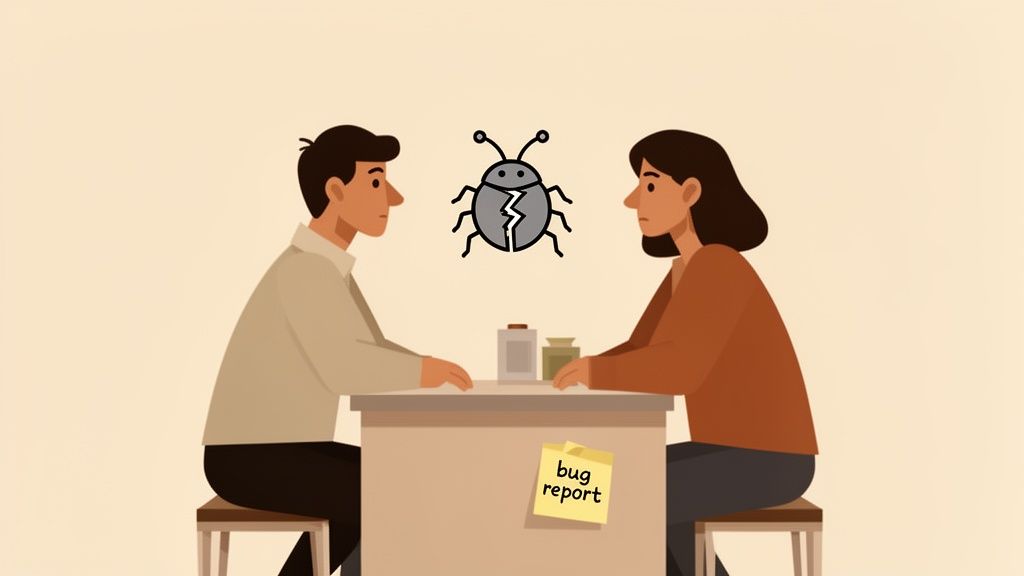
One of our worst fights started, as they often do, over something laughably tiny: one of us forgot to pay the internet bill. The first comment wasn't a big deal. The conversation spiraled anyway — accusations, a highlight reel of past grievances, then the heavy silence that fills a whole room.
We both retreated to our corners, feeling completely alone and misunderstood. It honestly felt like it could be the end of us.
That night, sitting in separate rooms, the same thought landed for both of us: our whole approach was broken. We were attacking each other instead of the problem. What if a fight isn't a moral failure, but the same unmet need showing up again in a new costume — something to solve together, not a case to prosecute?
That reframe shifted how we fought. We stopped trying to be right and got curious about why we kept landing in the same place. The unresolved issue itself was rarely the real threat. The way we talked about it was. We stopped asking "whose fault is this?" and started asking "what is it about how we talk to each other that let this happen?"
A few principles fell out of that, and we still live by them:
- Conflict is inevitable, not fatal. Every couple has issues that resurface. The goal isn't to eliminate them; it's to manage them without wanting to throw a laptop out the window.
- Understanding comes before solutions. You can't fix a problem you don't understand. We try to get the other person's experience before pushing our own agenda.
- A good process beats good intentions. "Just be nicer" when you're furious is a plan that fails on contact. A clear, agreed-on approach is the safety net for when emotions take over.
Our Old Way vs Our New Way
| Our Old Way of Fighting | Our New Way of Fighting |
|---|---|
| Goal: win the argument. Prove I'm right. | Goal: understand the problem. Solve it together. |
| Assumption: one of us is wrong (and it's probably you). | Assumption: we both have a valid perspective. |
| Tactic: attack, defend, bring up that thing from 2017. | Tactic: ask curious questions, listen, state needs. |
| Feeling: adversarial, like a battle. | Feeling: collaborative, like we're on the same side. |
| Outcome: one winner, one loser, lingering resentment. | Outcome: a little more trust, feeling closer. |
We moved from a battle to teamwork. The rest of this is the messy, surprisingly effective approach we built — by trial and a lot of error — to fight better and come out more connected, not less.
How to Prepare for a Hard Conversation
Trying to resolve anything while you're both angry almost never works. We learned the hard way that most of the work happens before the conversation starts. You have to create a safe enough container, or you're just lobbing verbal grenades.
For us that means slowing way down with a bit of prep. We call it our "pre-mortem," and it's non-negotiable now.
- Call a pause when things get heated. The second one of us feels our heart rate spike or our brain start shutting down, either of us can call a pause. It's not storming off — it's a timeout. The one rule: whoever calls it schedules the follow-up within 24 hours, so "pausing" never becomes permanent avoidance.
- Schedule a sync; don't ambush. We never spring a heavy topic right after work or when someone's clearly fried. It can sound laughably formal — "can we put 15 minutes on the calendar to talk about the dishwasher thing?" — but it means we're both prepared instead of reacting.
- Brain-dump first. Before we talk, we each take five minutes to jot down what we're feeling and what the core issue actually is. It clarifies our own heads so we don't word-vomit all over each other.
The goal of prep isn't to build your case. It's to get clear on your own feelings and needs so you show up with more curiosity and less accusation.
Part of this is using language that invites collaboration instead of triggering defensiveness — the fundamentals are in our beginner's guide to non-violent communication for couples. Instead of "we need to talk about your mess," we use something softer:
- "Hey, my brain is telling me a weird story about the dishwasher thing. Can we talk it through tonight after dinner?"
- "I'm feeling a little disconnected. Could we find some time this weekend to talk about it?"
Naming the conversation ahead of time makes it feel like a team tackling a problem, not two adversaries preparing for battle.
Try it: the next time something stings, don't address it on the spot. Say "can we talk about this tonight?" and use the gap to write down what you actually feel. The pause alone defuses half the fights we used to have.
Use Curiosity to De-Escalate and Actually Listen
This is the core of the whole thing. For years our conversations were a verbal boxing match — both of us just waiting for our turn to land a punch. Exhausting, and it got us nowhere.
The shift came when we changed the point of a hard conversation. Not to win. To understand the other person's experience of the situation. Not to agree — to get it.
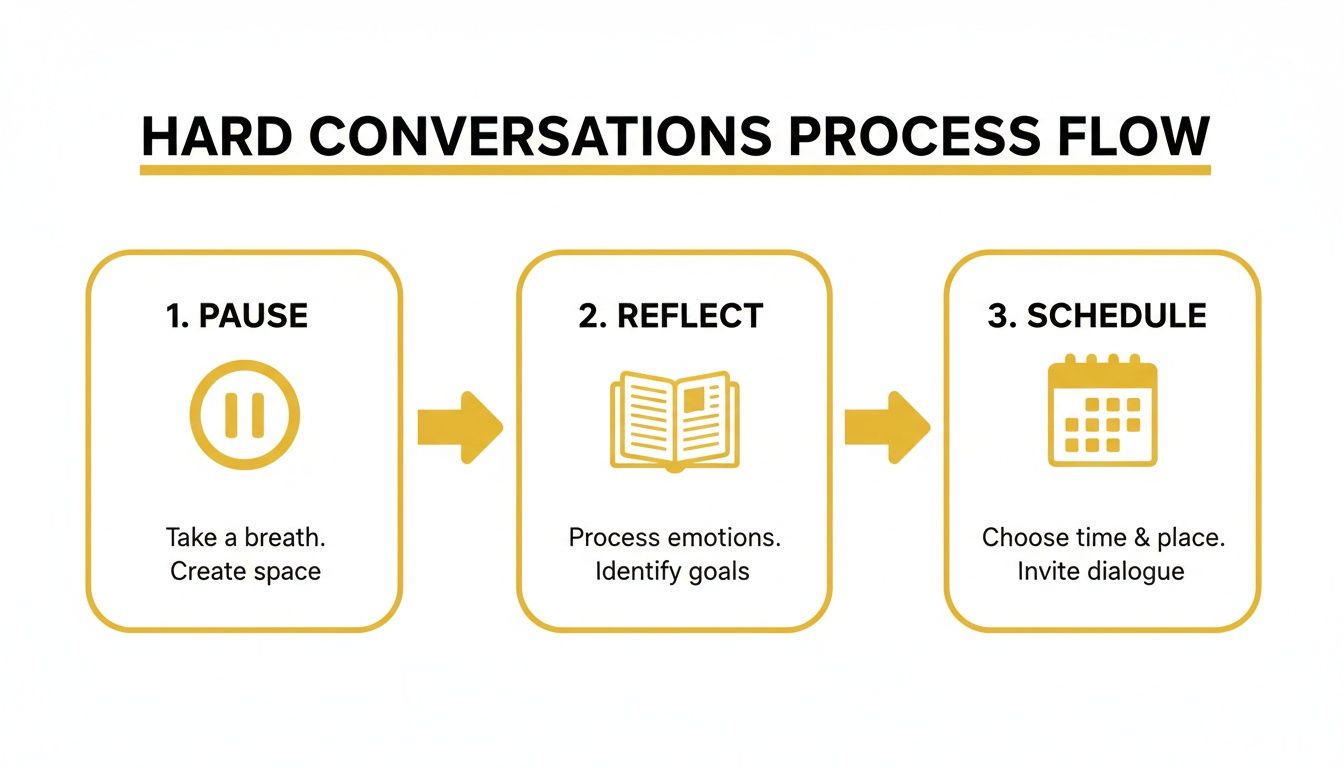
Pause, reflect, schedule. That sequence creates the space so we don't just react in the heat of the moment, which is what makes real listening possible.
Lead with Curiosity, Not Accusation
When we're hurt, the instinct is a statement: "you weren't listening," "you always do that." Statements get met with defenses. Questions get met with answers. Switching to genuine, open-ended questions signals you're trying to understand, not score a point. It took a lot of practice — and a lot of getting it wrong — but we have go-to scripts now:
- "Can you walk me through what you were thinking right then?"
- "What was the hardest part of that moment for you?"
- "What's the story you're telling yourself about what happened?"
- "Help me understand your perspective on this."
These force us to slow down and actually hear the answer instead of reloading. We've got more of these in our post on relationship communication exercises that actually work.
Try it: in your next disagreement, ask one real question before you make a single statement — and then actually wait for the answer. We treat "ask before you assert" as a hard rule when things get tense.
Name the Emotion, Not the Blame
The other half is looking honestly at your own feelings, which is harder than pointing a finger. "You always" and "you never" are relationship poison — impossible to defend against, and they put the other person instantly on the back foot.
So we shifted from accusation to expression. Instead of "you completely ignored me when your friends were here," we try "when everyone was talking over me, I felt totally invisible and alone." One is an attack on your character; the other is a window into my experience. It's much harder to argue with a feeling than with an accusation.
This was genuinely hard at first. Sometimes the only feeling we could name was "pissed off." So we made ourselves a cheat sheet — feelings (lonely, overwhelmed, misunderstood, insecure) and needs (to feel seen, to feel supported, to feel like a team) — to find what was really going on under the anger. Silly-looking training wheels that worked.
Try it: before you say "you," finish this sentence first: "I felt ___ when ___." If the only word you've got is "angry," dig one layer down — angry usually sits on top of hurt, scared, or unseen.
Make Concrete Repair Moves That Matter
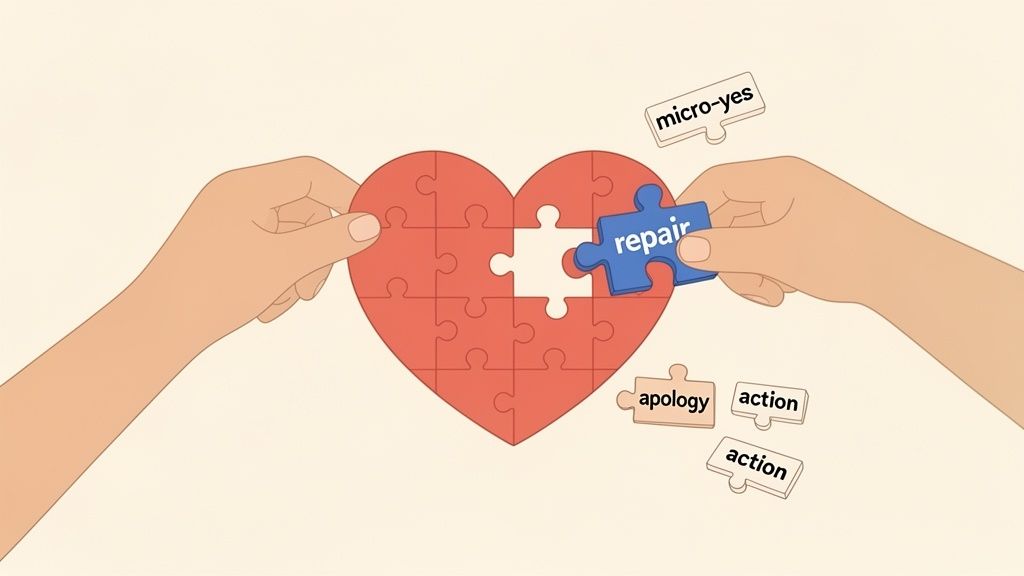
Talking is a start, but an apology without a change in behavior is just words. Real resolution means moving from talking to doing — what we call repair moves. After the listening and the naming-of-feelings, someone has to ask, "okay, what can I actually do to help fix this?" Not grand romantic gestures. Small, specific actions that prove you were listening.
The trick is finding the core need that wasn't met. It's almost never the literal thing — the dishes, the unanswered text — but what it represented: "I needed to feel like we were a team," or "I just needed to feel prioritized."
From Vague Apologies to Actionable Fixes
We've had some hilariously off-base repair attempts. Once, after a fight about feeling disconnected, one of us (okay, it was A) decided the perfect repair was to reorganize our shared grocery list app. Well-intentioned, comically misguided. The real need was screen-free time together, not a tidier way to buy milk.
Getting it right means brainstorming one small, doable change together:
The need: "I felt alone and unsupported when I was venting about work."
The repair move: "Next time you're telling me about a hard day, I'll put my phone face-down on the counter and give you my full attention for ten minutes before offering any solutions."The need: "I felt insecure and out of the loop at that party."
The repair move: "At the next social thing, I'll check in with you every so often — a quick squeeze of the hand or a shared glance — so you know we're still connected."
These small, specific commitments are the building blocks of trust. They prove you're paying attention.
Try it: after your next repair, name one concrete thing you'll do differently and put a number or a time on it ("phone away for ten minutes"). Vague good intentions evaporate; specific ones stick.
The Power of the "Micro-Yes"
When we're truly stuck, we hunt for the micro-yes: the smallest possible point of agreement. Sometimes it's just, "okay, can we at least agree this conversation feels awful for both of us?"
That one tiny yes breaks the stalemate. It creates a sliver of shared ground to build on — not solving the whole knot at once, just finding one loose thread to start untangling.
What separates healthy conflict from destructive conflict isn't the absence of fights. It's how quickly you move from attack mode to problem-solving mode, and the micro-yes is often the bridge that gets you there.
Try it: when you're deadlocked, stop arguing the point and find one thing you both agree on, however small. "We both hate that we're stuck here" counts. Shared ground beats being right.
The Weekly Ritual That Keeps Us Connected
The biggest lie about conflict is that you can fix a deep, recurring issue in one dramatic conversation. We tried that for years. It never worked. The real prevention happens in the follow-up.
So we have a non-negotiable weekly ritual — our "Growing Us" session. Think low-stakes check-in: about 20 minutes, usually Sunday night, just talking. Not rehashing old fights, but making sure the changes we agreed to are actually holding. We keep it light, or it would never happen. Three things:
- Check in on commitments. "That repair move from last week — phone away when you're talking about work — how did I do, one to ten?" Accountability without blame.
- Celebrate small wins. "I noticed you didn't sigh when I brought up the budget. Thank you." It sounds silly; acknowledging the effort makes us both want to keep trying.
- Catch small issues early. The most important part. "I felt a little disconnected this week with our schedules — can we plan a date night?" Flag the small annoyance before it ferments into resentment.
This low-pressure, consistent space has done more for us than any single high-stakes conversation ever could. The full version is in our guide to a weekly relationship check-in — the single best thing we've done to reduce how often and how hard we fight.
Try it: book one 20-minute check-in this week and start it with appreciation, not grievances. Starting on the good foot is what keeps it from turning into a complaint session.
FAQ
This all sounds great in a blog post, and real life is way messier. Trying a new way of fighting while you're fighting feels ambitious. These are the hard questions friends actually ask us, answered with our usual mix of self-deprecation and stuff that's actually worked.
What if My Partner Isn't on Board?
You can't force it. Announcing "we are now using a new conflict system!" goes about as well as you'd expect. Instead, model it. Don't announce the system; just use one piece of it.
- Instead of escalating: "I'm feeling really overwhelmed. Can I take a 10-minute pause before we continue?"
- Instead of accusing: "I really want to understand your side. Can you tell me more about why that was so frustrating?"
When your partner experiences a less-attacking response, it usually opens something. One of us (A) was way more resistant at first. It was only after seeing the other consistently de-escalate that the curiosity kicked in. Proof, right there in our living room.
This Sounds Exhausting. What if We're Too Tired for This?
Yes, it can be — especially early on. When you're tired and hurt, the last thing you want is a multi-step protocol. Our rule: a clumsy repair beats no repair. Sometimes the best you can manage is one honest sentence:
"I love you. I'm also really mad right now, and way too tired to talk about this well. Can we put a pin in it until tomorrow morning?"
That's a massive win. The goal isn't an enlightened conversation every time — it's to stop the bleeding. Over time, the weekly check-in actually saves energy, because you handle the small stuff before it becomes a multi-hour blowout.
What Happens if We Try This and the Fight Still Goes Badly?
It will. We promise. We still have days where we say all the wrong things and end up feeling miles apart. The point was never to stop failing — it's to get faster at the repair afterward. The conversation after the bad conversation is where the real learning happens. We literally use a script:
"Okay, that was a disaster. Where do you think we went off the rails?"
That reframes the failure from a moral one ("you're a jerk") to a problem you can both look at. You're working on how you communicate, not attacking each other's character.
How do we stop having the same fight over and over?
If a fight keeps coming back, the topic probably isn't the real topic. The recurring dishwasher argument is rarely about the dishwasher — it's about labor, feeling unseen, or carrying the mental load alone. The move is to name the pattern instead of relitigating the plates: "I think we're in the loop again." We wrote a whole guide on breaking the argument you keep repeating if this is your recurring one.
At Growing Us, we built a simple ritual to make these conversations easier. Our card deck and app give you a starting point for weekly check-ins — and the AI coach can gently notice when defensiveness creeps in or when you skate past a feeling — helping you turn the messy moments into real, lasting growth.